Capers
Leagues, ladders and tournaments for friend groups, clubs and intramural teams.
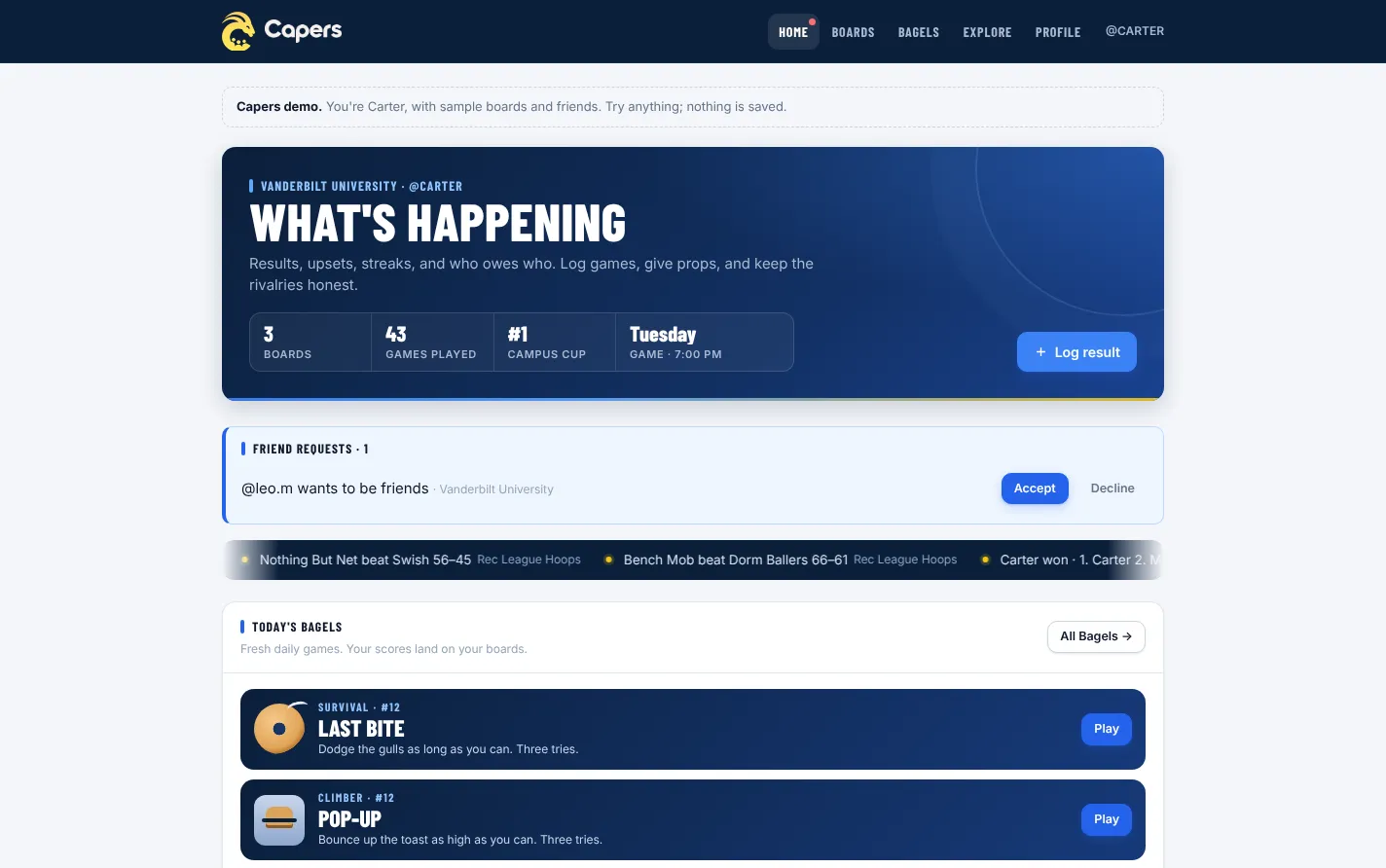
The problem
Our group chat couldn’t settle who was actually best at ping pong. Every friend group, club and intramural team keeps score somewhere — a notes app, a spreadsheet, memory — and none of it survives an argument.
What it does
Capers gives each crew a board. Log a result and everyone’s standings move. Boards hold games that each work their own way: head-to-head, finishing order, best score or time, running total. On top of that sit challenges, tournaments, badges, events with RSVPs, friends, teams with captains, and season schedules an organizer can design down to which court plays when.
How it’s built
One small Node build script (no framework, no bundler) joins the CSS and JavaScript into one page and produces three
targets from the same code: the website, a Claude artifact, and a demo with sample data. A Store layer gives all
three the same Firestore-style API.
- Sign-in without passwords. Two serverless functions email and check six-digit codes. Codes are stored only as hashes, expire in ten minutes, allow five tries and are rate-limited per email and per network. A verified code becomes a Firebase custom token.
- Data locked down on the server. Firestore security rules keep a private board’s results, chat and events to its members, and keep emails and phone numbers private to each person.
- Ratings that learn in hindsight. Besides classic Elo, one rating refits a Bradley–Terry model to the whole season after every game, so a loss to someone who later proves strong costs less.
- Tested like a user. Playwright flows act out different people on desktop and phone sizes, plus a run against the Firebase emulators for sign-in and rules.
Where it lives
Capers is its own brand at joincapers.com. This page is its entry in the danielravel.com registry; the app itself carries no personal branding.